
From line to volume: the origins of patternmaking
Published on
A short history of patternmaking: the origins of flat cutting
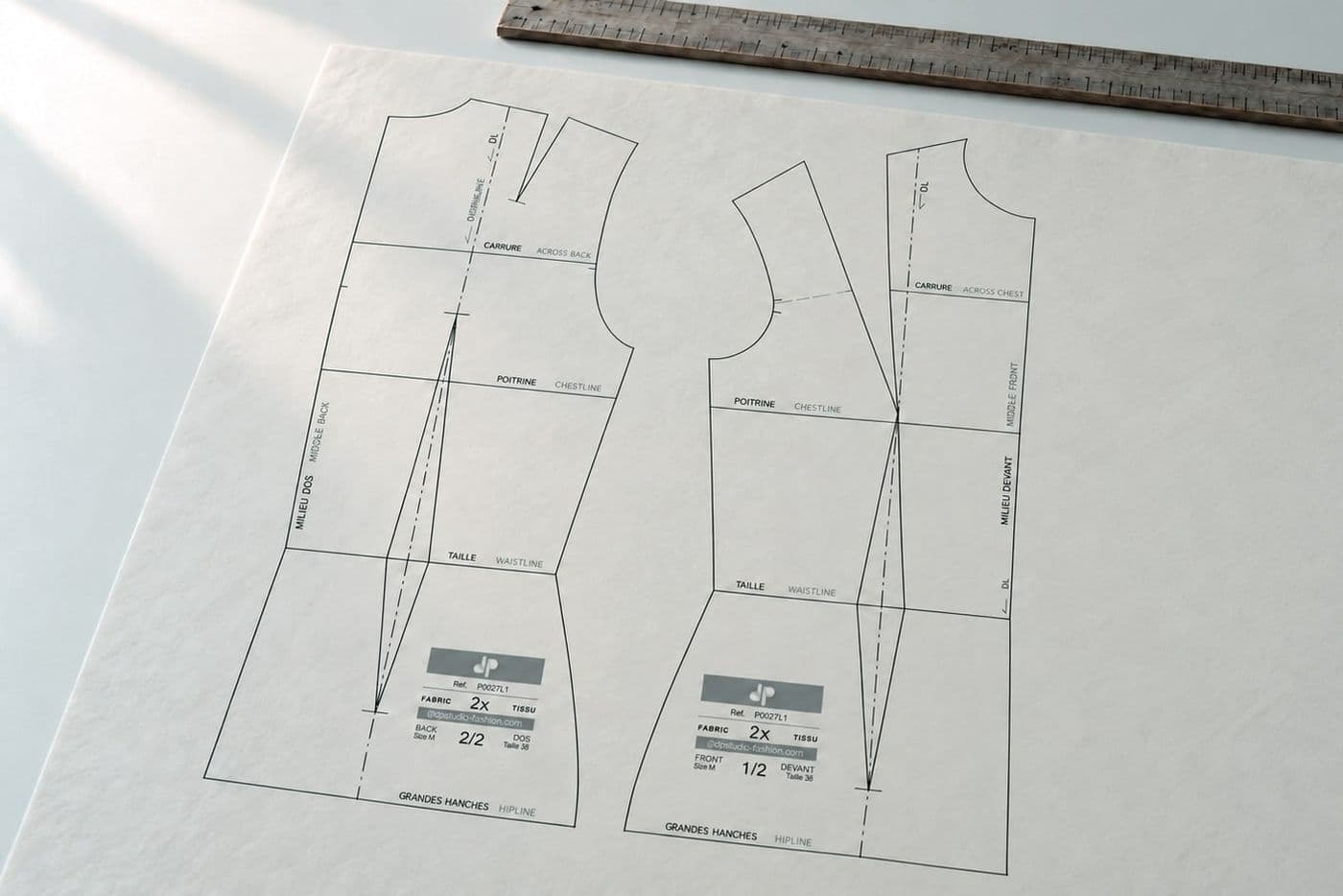
How can the volume of a body be represented on a flat surface? This question lies at the heart of patternmaking. Long before today’s patterns, artisans were already developing drafts to cut out the different pieces of a garment.
Flat cutting was not born of a single invention: it was built up gradually, through the passing on of know-how and its formalisation in books.
Long-standing practices among tailors
Tailors’ pattern books bear witness to a long-standing use of geometry in the making of garments. In the Renaissance, books already showed the shapes of garment pieces and how they were laid out on the fabric.
The book by Juan de Alcega, an edition of which was published in Madrid in 1589, is an example of this tradition. It reflects thinking about drafting and the organisation of cutting, without yet corresponding to the methods of constructing base patterns that we use today.
These documents remind us that drawing pieces flat long predates the appearance of commercial patterns.
In the 18th century, know-how is documented
In France, François-Alexandre-Pierre de Garsault published L’Art du tailleur in 1769. The work covers, among other things, menswear, stays for women and children, and the work of the dressmaker. It helped to put into writing techniques that until then had largely been passed on in workshops.
This documentation made it easier to preserve and spread the knowledge needed to construct garments.
The 19th century: the development of cutting methods
In the 19th century, cutting systems based on measurements and proportions developed. Books offered organised approaches for moving from measuring to drafting.
In France, François Ladevèze notably published a Cours de coupe du tailleur de Paris in 1874. Later editions of his method refer to a system created in 1860, then modernised and refined. These publications illustrate the desire to make cutting explainable, teachable and reproducible.
Modern flat-cutting methods grew out of this evolution: using measurements, constructing reference lines and checking the shapes obtained.
Paper patterns open sewing up to a wider public
Another important step was the spread of ready-to-use patterns.
In 1863, Ebenezer Butterick and his wife Ellen founded their pattern company in the United States. The development of commercial patterns helped to make garment-making more accessible outside professional workshops.
A distinction must nevertheless be made between constructing a pattern from measurements and using a pattern that has already been drawn: the two practices are linked, but they meet different needs.
A legacy that endures
Today, flat cutting makes it possible to construct base patterns and then transform them to create designs. Draping explores volumes directly on a dress form; the two approaches can complement each other.
Paper and digital tools offer different media, but the principle remains the same: translating a volume into pieces that can be cut and assembled. Learning patternmaking means continuing this age-old search for balance between the measurements of the body, the material and the shape of the garment.